Nami’s State After Resurrection
5 Centimeters per SecondNami’s state after resurrection is defined by an irreparable exchange: her lover, Eve, brought her back from death and died in return. Nami’s account reveals that resurrection in Agartha does not simply restore what was lost; it can leave the survivor alone with the cost of having tried. Through her testimony, the story turns Morisaki’s search for a way to recover the dead into a question of what such a return demands of the living.
A Resurrected Witness
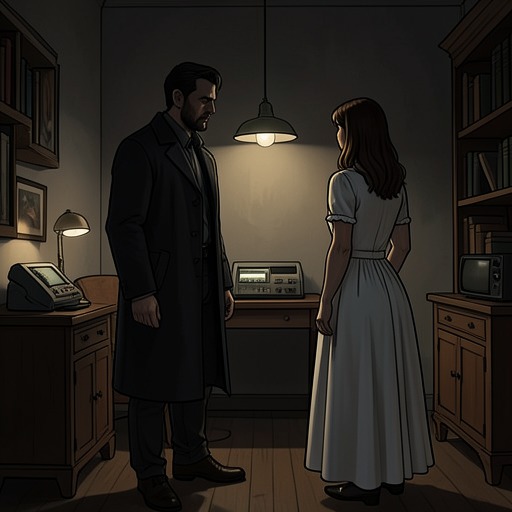
Nami enters the conversation as an exception to what Morisaki has been told. He has heard that no one in Agartha has resurrected the dead, but Nami clarifies that someone was brought back by a lover. Morisaki’s startled response and Asuna’s momentary uncertainty register how difficult it is to fit this living speaker into the rule they thought they understood. Nami is not describing resurrection at a distance: she identifies herself as the person who died and returned.
She gives one concrete measure of that experience: five years have passed since her death. The statement establishes the interval from her death, not the circumstances of her life during those years or the precise timing of her return. What she does make clear is that her existence now rests on an act of love whose consequences remain present. She speaks as both the beneficiary of resurrection and the person left to account for its price.
Eve’s Life as the Price
Nami first asks whether Morisaki knows that resurrection has a price. When he presses her to explain, she says the payment varies with the time, the situation, and the individual. The rule is therefore not presented as a fixed tariff that could be calculated in advance. Its uncertainty makes the possibility of resurrection harder, not easier, for Morisaki to pursue: the desire to bring someone back does not come with a reliable way to know what will be taken.
Morisaki hesitates before asking whether this is why Eve is absent. Nami confirms his inference. The price of bringing Nami back was Eve’s life: a life exchanged for a life. That answer gives the rule its human scale. Eve was not an abstract payment but Nami’s lover, and Nami’s survival did not preserve the relationship that had made her return possible. The outcome is a stark reversal of the hope behind resurrection: Nami remains, while the person who wanted her to live is gone.
Survival and Bereavement
Nami describes the sacrifice as having been for nothing, because she could find no meaning in a world lived without Eve; what she had wanted was for the one she loved to continue living. Her account thus distinguishes being restored from being made whole. The resurrection succeeds in returning Nami, but it fails to give her the future she desired. In the exchange, the saved life cannot substitute for the lost one.
Asuna’s response gives the story a second way to understand that cost. She thinks of O. Henry’s The Gift of the Magi, but distinguishes its warmth from the cruelty and heartbreak of Nami’s situation. The comparison recognizes the shape of reciprocal sacrifice while refusing to treat the outcome as a consoling romantic paradox. Afterward, Morisaki and Asuna return to the boat without speaking. Asuna eventually asks whether resurrecting people is truly right. The question follows directly from Nami’s testimony: the issue is no longer only whether the dead can return, but whether a return purchased through another person’s death can be called a good outcome.
The Lesson of Irreplaceable Loss
Nami’s story supplies a concrete precedent for Morisaki’s pursuit of resurrection, but it does not establish what price would be demanded in any other case. That uncertainty matters. Her experience warns him of the danger without offering a calculation that would let him control it. The personal cost is known only after the exchange has taken place, and the person brought back cannot undo it.
Later, as Morisaki breaks down and asks Shin to kill him, Shin refuses. He says that his brother spoke to him and urged him to embrace loss and keep living. Asuna then slowly opens her eyes while Morisaki’s tears fall on her cheeks. The scene does not identify Nami as the cause of Shin’s words, nor does it say that every resurrection carries the same price. Instead, set beside Nami’s account, it sharpens the contrast between trying to cancel death and learning to live after it. Nami survives, but her testimony shows the loneliness that survival can contain; the later appeal to continue living offers no restoration of what has been lost, only a way forward that does not demand another life in exchange.